MacroSnaps26 October 2026
No. 107Lula has just won a fourth term as Brazil's president. Waiting for him: an interest bill that, for the size of the economy, is bigger than Greece's at the worst of its debt crisis.
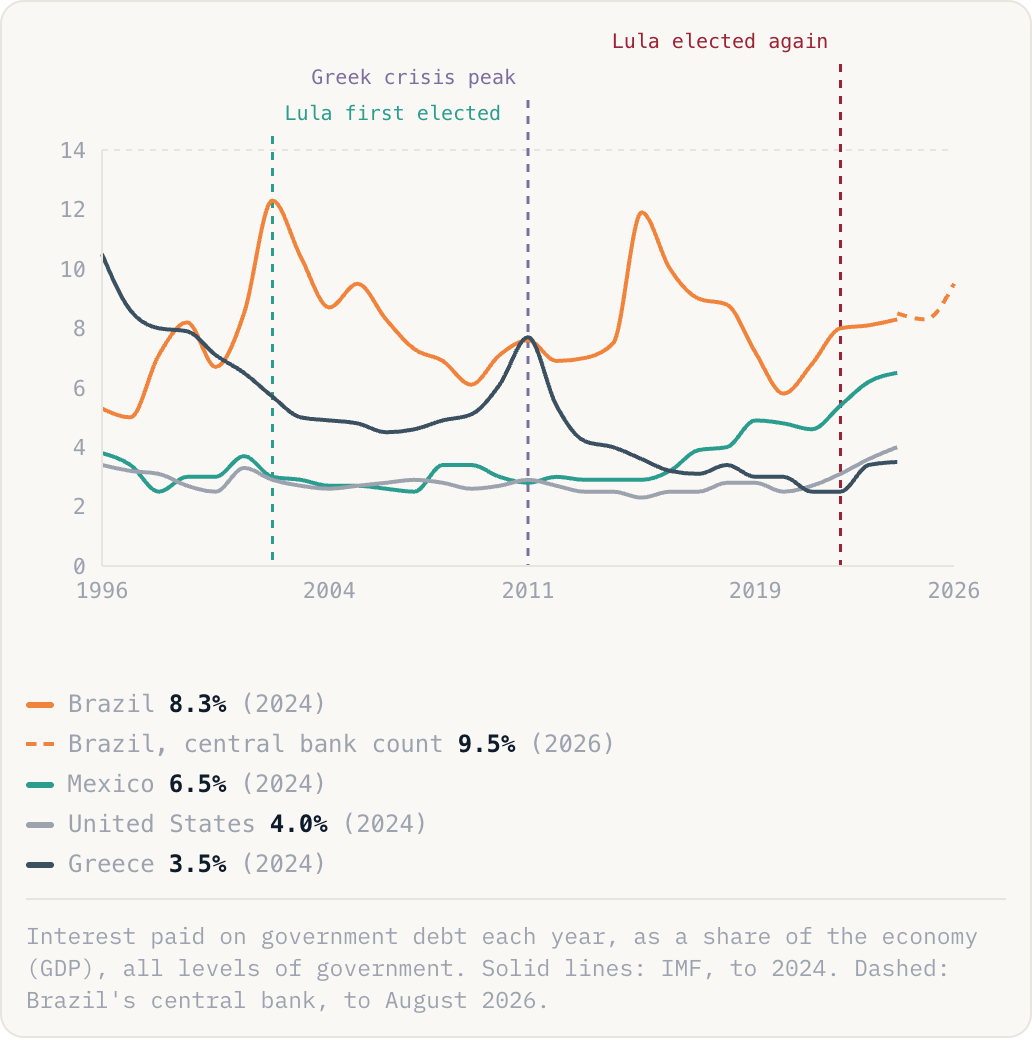
Brazil8.3%(2024)Brazil, central bank count9.5%(2026)Mexico6.5%(2024)United States4.0%(2024)Greece3.5%(2024)
Interest paid on government debt each year, as a share of the economy (GDP), all levels of government. Solid lines: IMF, to 2024. Dashed: Brazil's central bank, to August 2026.
Why this is happening
- Prices won't settle. Inflation has run above the 3% target for two years, peaking at 5.5% in 2025. Jobs are plentiful, and the government keeps spending more on family benefits and on pensions that rise with the minimum wage.
- So borrowing costs 15%. The central bank raised its interest rate to 15% in 2025, the highest in nearly 20 years, and it is still 13.75%. It brakes this hard partly because 44% of loans are cheap government credit its rate cannot touch.
- And the government pays that rate too. Half its debt is tied to it. Brazil owes less than America for the size of its economy, but pays twice as much interest: about R$1.3 trillion a year, more than it spends on schools or health.
The take
Lula has escaped this trap before. When he first won in 2002, markets panicked and interest ate 12% of the economy; he kept a tight budget and by 2009 the bill had halved, helped by a commodity boom. This time the IMF expects the debt to pass 100% of GDP by 2028. If he spends to keep his voters happy, interest rates stay high and the bill grows. If he cuts, the people who just elected him feel it.