MacroSnaps24 October 2026
No. 105For fifty years pop songs said “love” just as often and simply grew longer around it. In the last ten years they started saying it less.
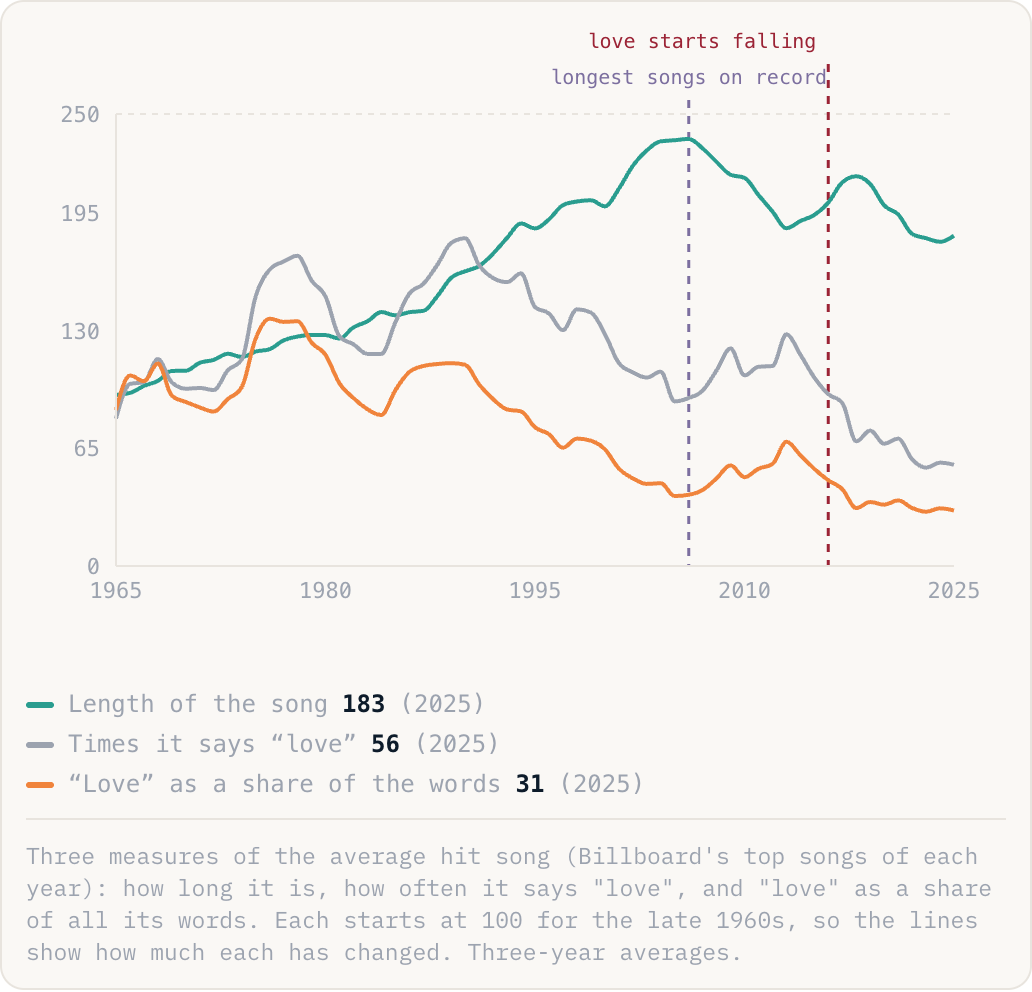
Length of the song183(2025)Times it says “love”56(2025)“Love” as a share of the words31(2025)
Three measures of the average hit song (Billboard's top songs of each year): how long it is, how often it says "love", and "love" as a share of all its words. Each starts at 100 for the late 1960s, so the lines show how much each has changed. Three-year averages.
Why this is happening
- For fifty years this was arithmetic, not feeling. Songs grew from 231 words to a peak of 546 in 2006, while "love" was sung about as often as in the 1960s, so its share of the words fell even though no one sang it less.
- Since 2015 that has changed. Songs have stopped growing, yet "love" now comes up about half as often: 1.6 times a song, down from 3.0.
- Fewer hits mention love at all: about two thirds of top-40 songs in the late 1980s, under half today. However you measure it, love is fading from the charts.
The take
A share can fall for two different reasons, and only one of them says something about people. For fifty years, love's falling share was just songs getting wordier: singers said "love" as often as ever. In the last ten years they really have started saying it less. Anyone who read this chart in 2015 would have said nothing was happening. Something was about to.