MacroSnaps10 August 2026
No. 30The chip in your pocket holds over a hundred billion transistors; the first held about 2,000.
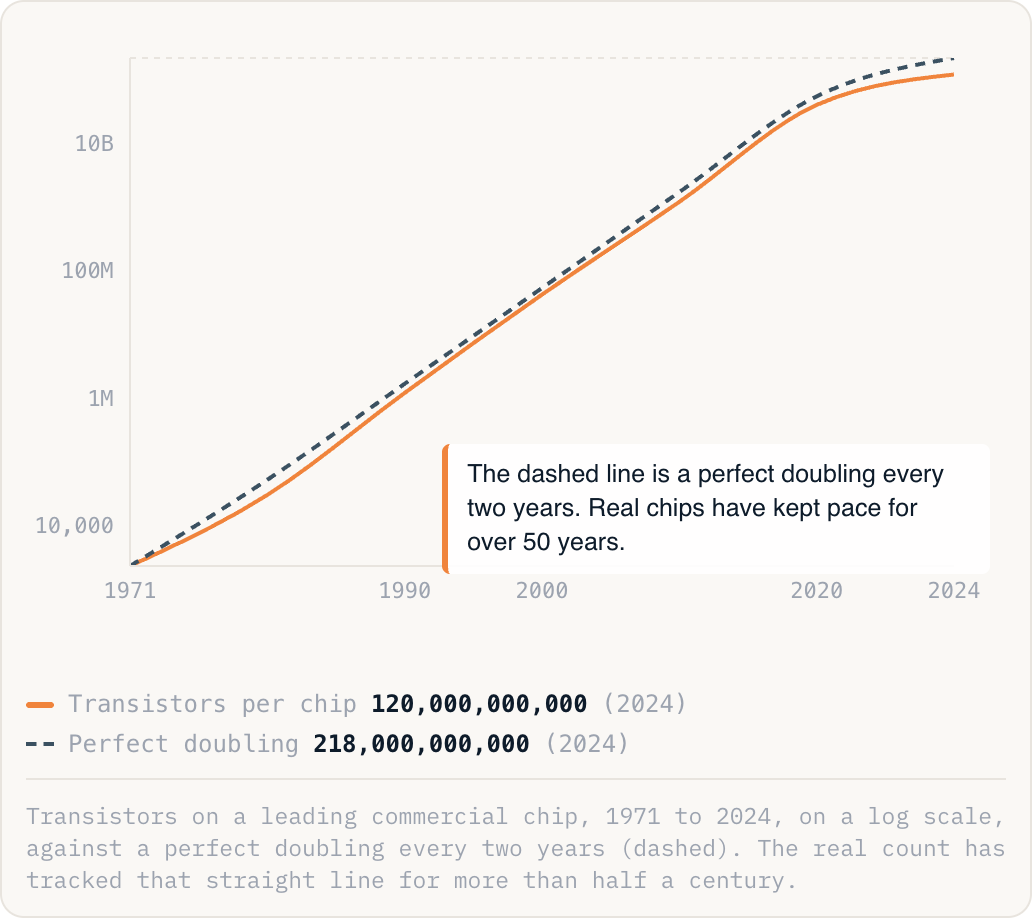
The dashed line is a perfect doubling every two years. Real chips have kept pace for over 50 years.
Transistors per chip120,000,000,000(2024)Perfect doubling218,000,000,000(2024)
Transistors on a leading commercial chip, 1971 to 2024, on a log scale, against a perfect doubling every two years (dashed). The real count has tracked that straight line for more than half a century.
Why this is happening
- Shrinking each transistor lets engineers pack twice as many onto the same silicon every couple of years, the pattern Gordon Moore named.
- Each generation funded the tools to build the next, turning the doubling into a self-sustaining industry roadmap.
- Cheaper transistors made computing cheap enough to spread into phones, cars and almost every device.
The take
This doubling is the engine under every other technology story. AI, smartphones and the internet all ride on the same line climbing off the chart.