MacroSnaps3 September 2026
No. 54Every Olympic Games on record has gone over budget. All 23 of them, without a single exception.
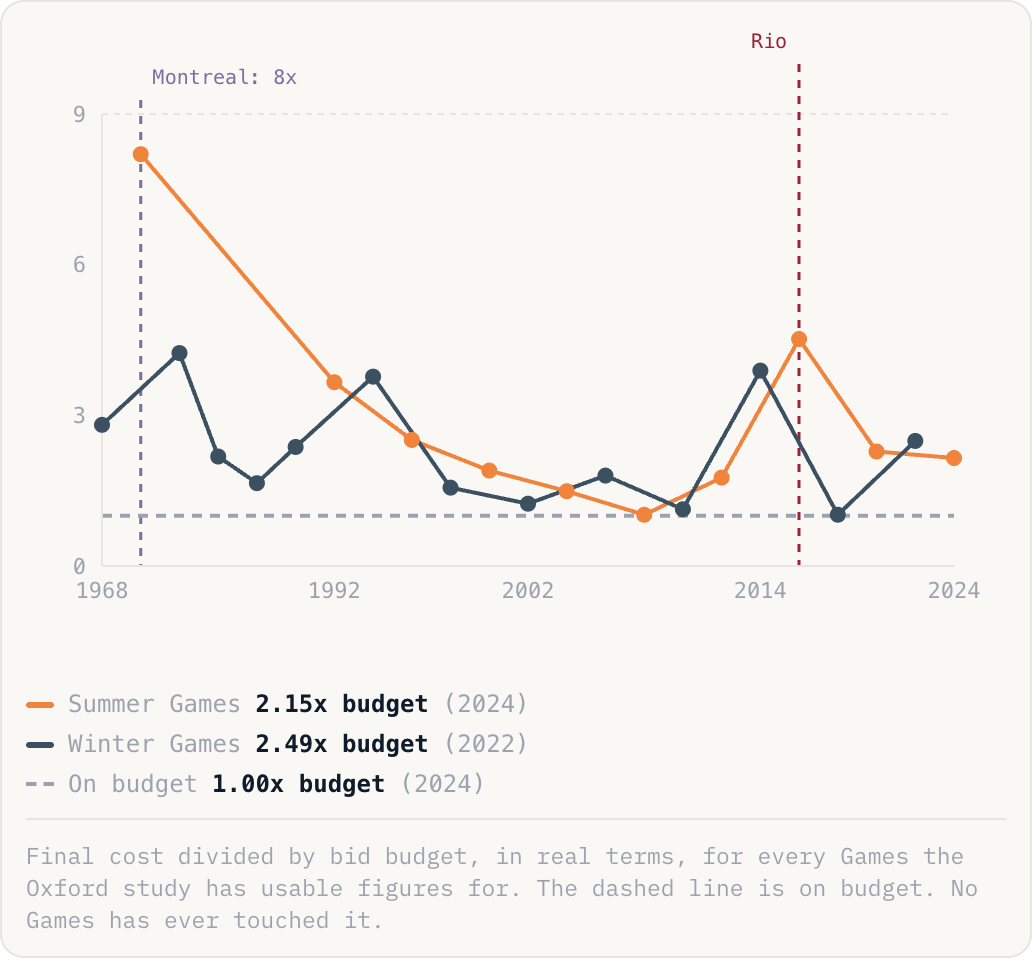
Summer Games2.15x budget(2024)Winter Games2.49x budget(2022)On budget1.00x budget(2024)
Final cost divided by bid budget, in real terms, for every Games the Oxford study has usable figures for. The dashed line is on budget. No Games has ever touched it.
Why this is happening
- The bid is not really a forecast, it is a sales document. Cities compete to be chosen, so the incentive is to publish the lowest number that will still win, and the study calls the result a 38% down payment on the real cost.
- The host government signs a guarantee to cover any overrun, which the researchers name Blank Check Syndrome. Once the cheque is signed and the opening date is fixed by treaty, there is no way to trade cost against scope or time, so every problem is solved by spending more.
- Nothing has fixed it. The IOC ran a Knowledge Sharing Programme from 2000 to spread lessons between hosts, and the study tests it directly: overruns fell until 2008 and have risen since.
The take
Of the 25 categories in the Oxford database, the Olympics is the only one where not a single project has come in on budget. Solar power comes in on or under budget 61% of the time, roads 42%, even nuclear power 3%. The Games are at zero. That is not bad luck across 23 tries, it is a bidding process that rewards the most optimistic number, and any city considering a bid should read its own budget as an opening instalment.
Source: Budzier and Flyvbjerg, The Oxford Olympics Study 2024