MacroSnaps2 November 2026
No. 114More American fund money now sits in funds that simply copy the market than in funds that try to beat it.
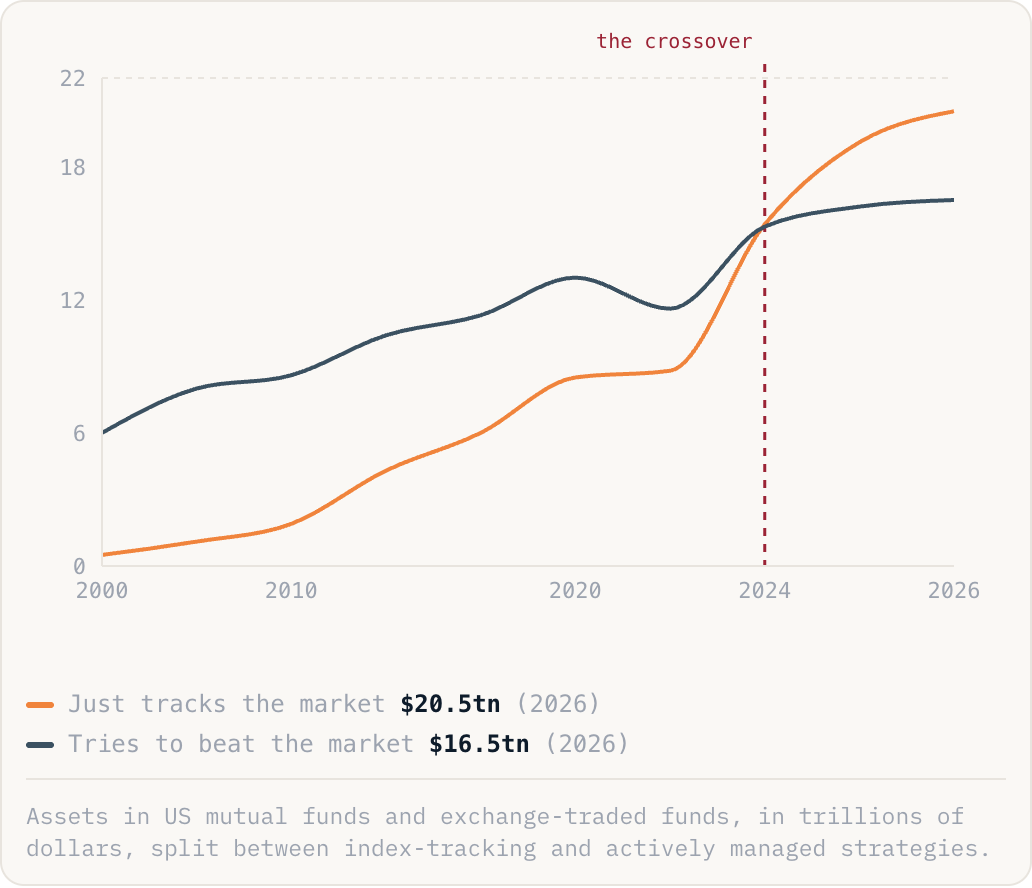
Just tracks the market$20.5tn(2026)Tries to beat the market$16.5tn(2026)
Assets in US mutual funds and exchange-traded funds, in trillions of dollars, split between index-tracking and actively managed strategies.
Why this is happening
- The arithmetic is unforgiving. All investors together own the whole market, so before costs the average active manager must earn exactly the market return. After fees, investors in the average active fund get the market return minus the fee.
- The evidence matched the arithmetic. Over the 15 years to 2024, S&P's scorecard found that about 90% of US large-company active funds failed to beat their index, and the winners changed from decade to decade, so picking them in advance was close to guessing.
- Costs did the rest. A typical active US equity fund charges around 0.6% a year, a big index fund around 0.03%. Over 30 years, that difference alone shrinks the final pot by about 15%.
The take
Index funds grew into one of the biggest businesses in finance on a simple finding: paying experts to pick shares usually left investors worse off. But there is a catch. Share prices stay sensible mainly because active investors study companies and trade on what they find. Index funds simply accept those prices. If nearly everyone switched to index funds, few would be left checking whether prices made sense.