MacroSnaps12 July 2026
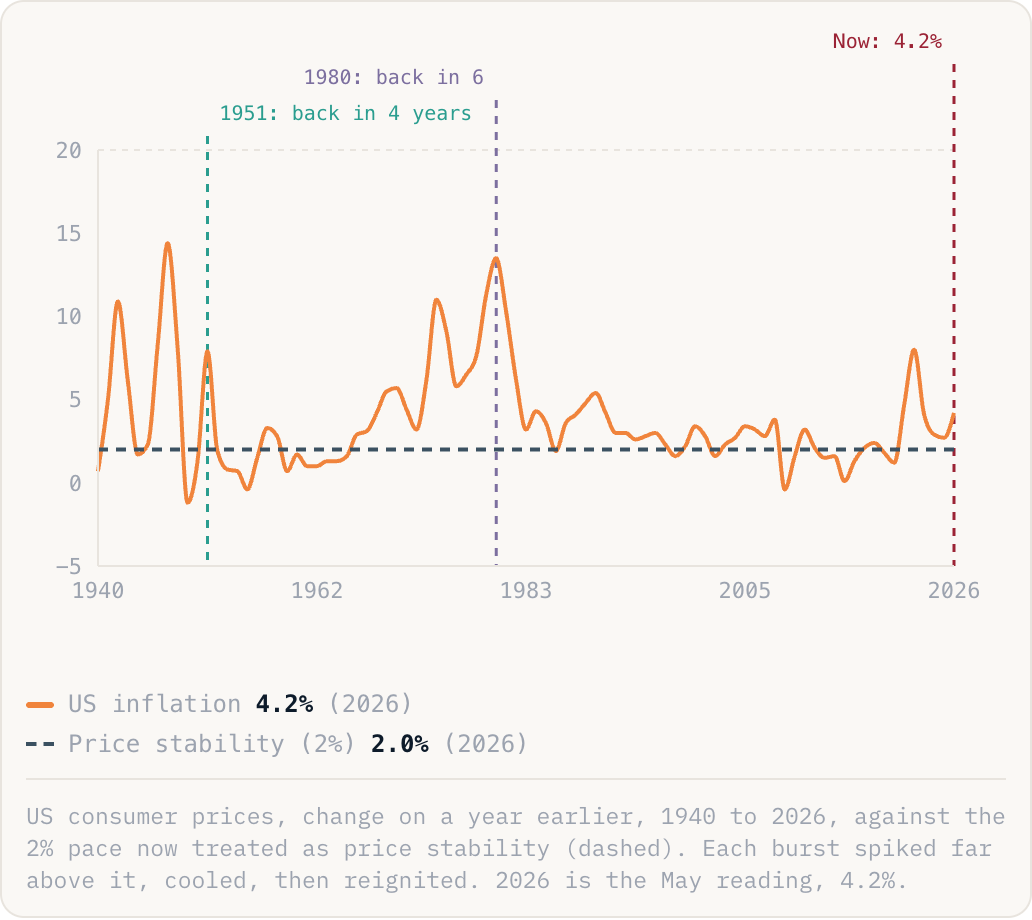
No. 07The US has twice declared victory over inflation. Both times it came back within six years.
US inflation4.2%(2026)Price stability (2%)2.0%(2026)
US consumer prices, change on a year earlier, 1940 to 2026, against the 2% pace now treated as price stability (dashed). Each burst spiked far above it, cooled, then reignited. 2026 is the May reading, 4.2%.
Why this is happening
- A big inflation gets beaten while its fuel is still in the system. Wages, rents and government budgets are all still catching up to the first wave, so prices stay primed underneath.
- The second wave has always arrived on a shock: the Korean War in 1950, the Iranian revolution and its oil crisis in 1979. This year it is energy again, up 23.5% in a year after the conflict with Iran.
- Relief gets trusted too soon. In 1948 and 1976 money was loosened as soon as prices cooled, so the next shock landed on an economy that was already running warm.
The take
History does not say inflation must come back: it says the first all-clear is often false, because a second wave needs only one shock to start, and the world just supplied one. With prices rising 4.2% a year again, 1951 and 1980 are worth remembering.